
EU Inc. - What it really means for your startup
Starting a company in Europe is still a bit like playing a game where the rules change every time you cross a border. And as you can imagine, that doesn’t exactly make scaling easy. The European Commission is working on a new legal company form, often called "EU Inc." or "the 28th company law regime".
The goal is ambitious but clear: reduce legal fragmentation in Europe and make it easier for companies to start, scale and operate across borders.
For founders building across borders, that fragmentation translates directly into higher costs, slower growth and more complexity, exactly the things you don’t want when you’re trying to move fast.
Recently, Cresco hosted a seminar on the EU Inc. proposal. The discussion focused on what EU Inc. actually is, which problems it tries to solve, and where the real opportunities and risks lie for startups and scaleups.
👇 Here are the key takeaways, focused on what matters for founders.
What problem is the EU trying to solve?
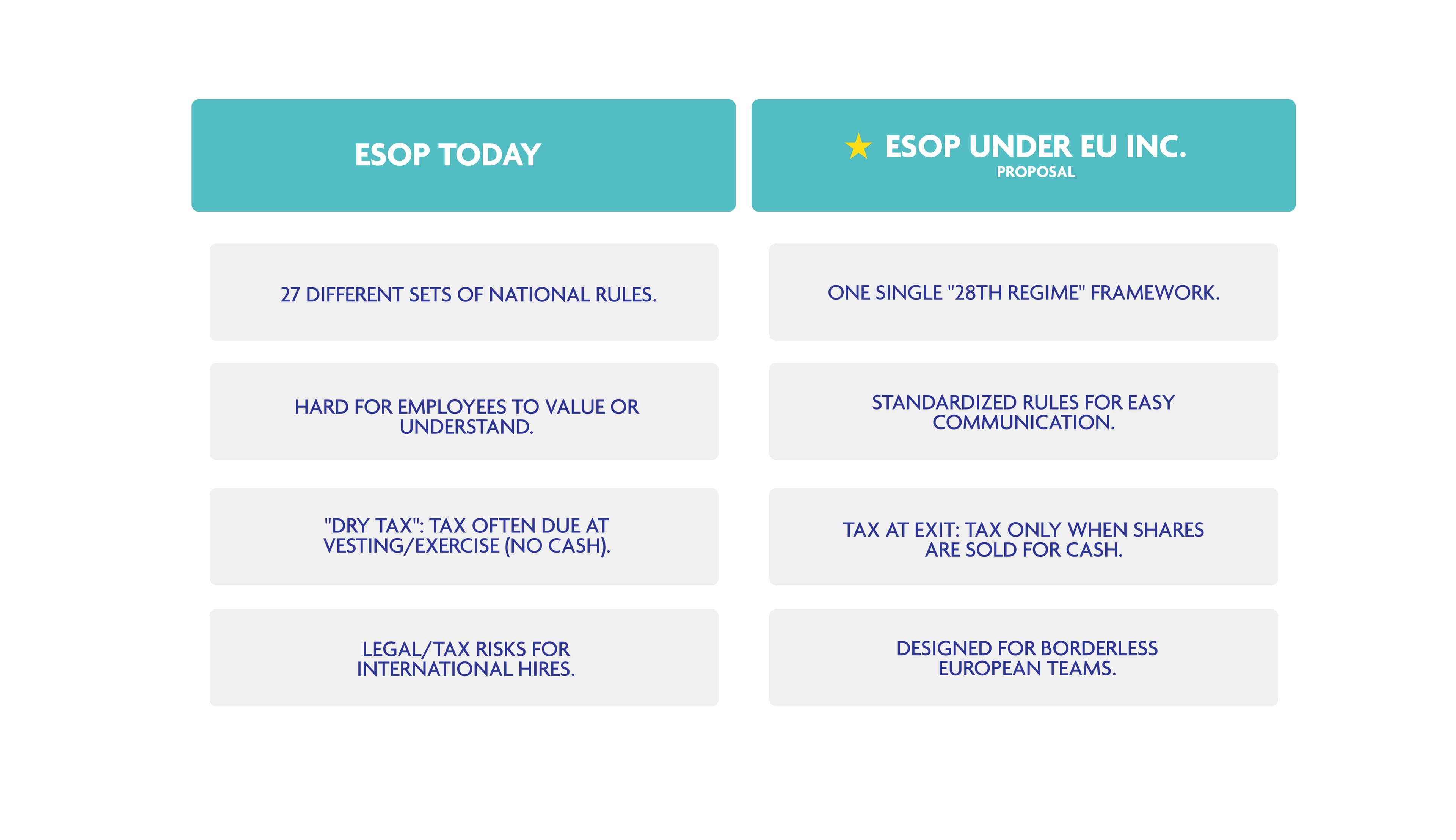
Today, Europe has 27 separate national legal systems. Each one comes with its own rules, procedures and company forms. For founders who want to grow internationally, this creates real friction: more legal work, higher costs, slower expansion, and added complexity for investors.
The European Commission sees this fragmentation as a structural barrier to Europe’s competitiveness and innovation. EU Inc. is meant to help by adding one optional, European‑wide company form on top of existing national ones.
What’s different this time compared to earlier failed attempts (such as the European Private Company in 2008 and the Single‑Member Company in 2014) is political momentum. According to the speakers, there is a real will to move this forward — even though challenges and resistance remain.
Importantly, EU Inc. is not a replacement for existing company forms such as the BV, GmbH or SAS. It is an additional option founders can choose if it better fits their growth strategy.
What exactly is EU Inc.?
In simple terms, EU Inc. would be:
- a limited liability company
- with legal personality
- that can be founded by one or more founders
- and used either as a standalone company or within a group structure
A key point from the seminar:
Any company can become an EU Inc.
The proposal is not limited to startups or “innovative” companies — even though that was the original idea in early policy discussions.
That said, reality is more nuanced. The EU regulation only covers certain company law topics. Everything it does not regulate falls back to national law in the country where the EU Inc. is registered. Each Member State will choose a national company form whose rules fill in those gaps.
The result? 27 different “flavours” of EU Inc.
Same backbone, different local toppings. A Spanish EU Inc. and a Dutch EU Inc. will not be identical.
Fast, digital and low‑cost by design
One of the most concrete and founder‑relevant aspects of the proposal is how companies would be set up.
If founders use standard EU templates for the articles of association (to be provided by the Commission):
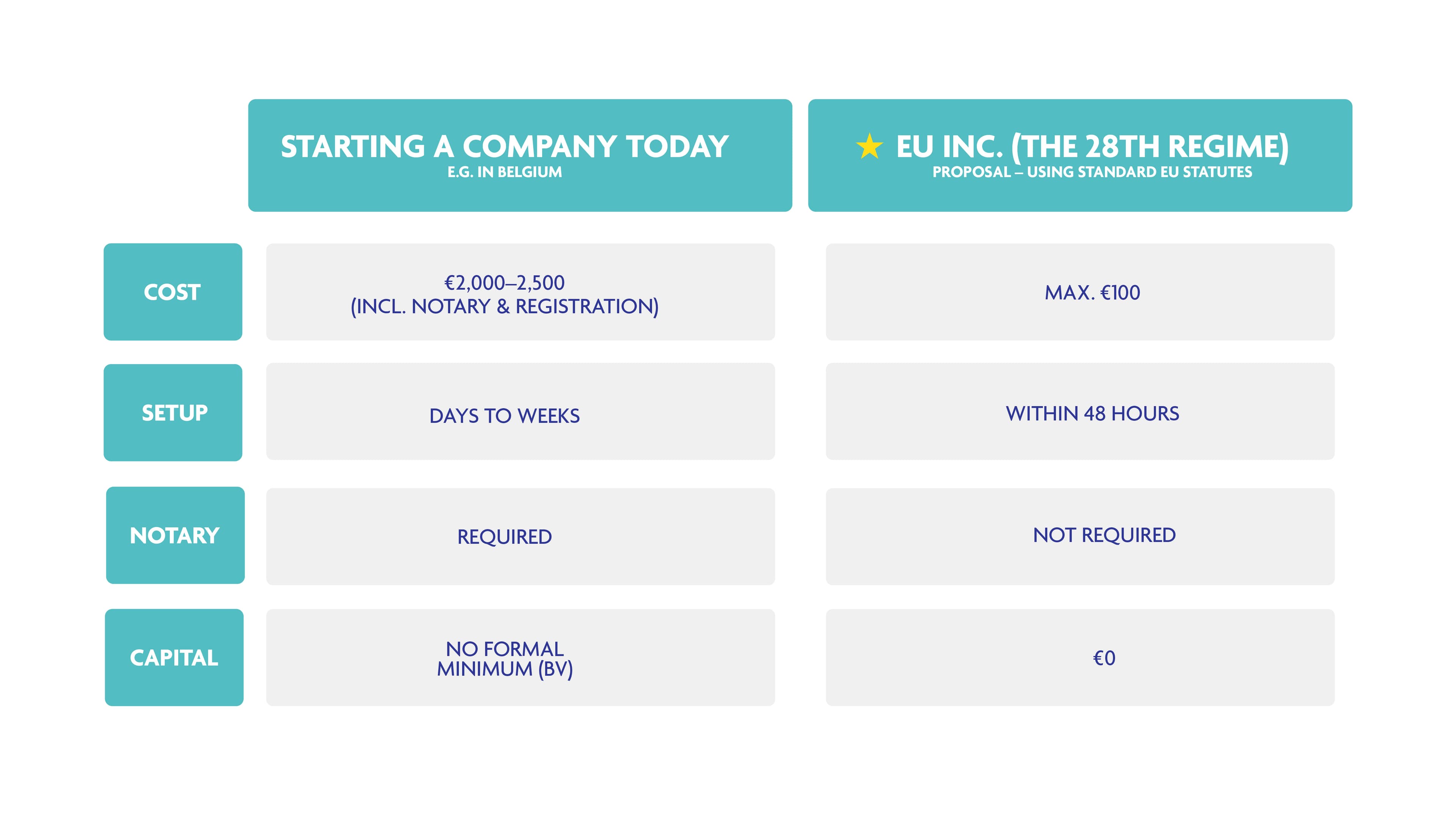
- incorporation can happen fully online
- within 48 hours
- at a maximum cost of €100
- without a notarial deed
Founders who prefer customized articles of association (for more complex structures) can still incorporate digitally, but the process may take up to five working days and comes with no cost cap.
For context: during the seminar, speakers noted that incorporating a company in Belgium today typically costs €2,000–€2,500 once you include notary fees, publication costs, company registration and the required financial plan.
In other words: what takes time, paperwork and a few thousand euros today could soon be done in a couple of clicks for a fraction of the cost.
The EU Inc. fast‑track would significantly lower that barrier — provided founders are willing to work with the standard templates.
The articles of association must also be machine‑readable, stored as structured data, and available in both a local language and the language of international business (in practice: English). When the EU templates are used, both language versions have equal legal value.
A capital structure designed with startups in mind
For startups, the capital rules are among the most relevant parts of the proposal.
In practice, this translates into much more flexibility for founders and investors — and fewer awkward workarounds:
EU Inc. would:
- have no minimum capital requirement
- work with non‑par value shares by default
- allow multiple share classes and flexible voting rights
- explicitly support modern funding instruments such as convertibles, SAFEs and KISS
Share transfers are designed to be simple and fast, without formalities that still exist in some national systems today.
EU employee stock option plan (EU‑ESO)
Employee Stock Option Plans remain highly fragmented across Europe. EU Inc. tries to improve this — carefully.
The proposal introduces a European ESOP framework, allowing stock options to be granted to:
- employees
- board members
- employees of subsidiaries
Taxation would happen only when the shares are sold, not at grant, vesting or exercise.
That’s a big deal: no taxes before there’s actual liquidity.
There are, however, clear limits:
shareholders holding more than 25% of the company (or who held such a stake in the previous 24 months) are excluded only employees and board members are eligible tax treatment itself remains national.
Still, this is a meaningful step towards more consistent employee participation across borders.
One important constraint highlighted during the seminar: founders who once held more than 25% but later diluted below that threshold cannot receive EU‑ESO options. This could create tension for founding teams at later stages who want to realign incentives.
Reality check: there will not be “one single EU Inc.”
A crucial takeaway from the expert discussion is that EU Inc. will not fully replace national company law.
In short:
- EU Inc. is governed by EU rules and its articles of association
- everything not covered falls back on national company law
Each Member State decides which national company form supplements EU Inc.
So yes, things get simpler, but not simple.
As a result, the choice of country of incorporation will still matter, even under an EU Inc. framework.
Timing and political momentum
Earlier European company forms failed due to lack of political support. This time, the political wind is clearly stronger.
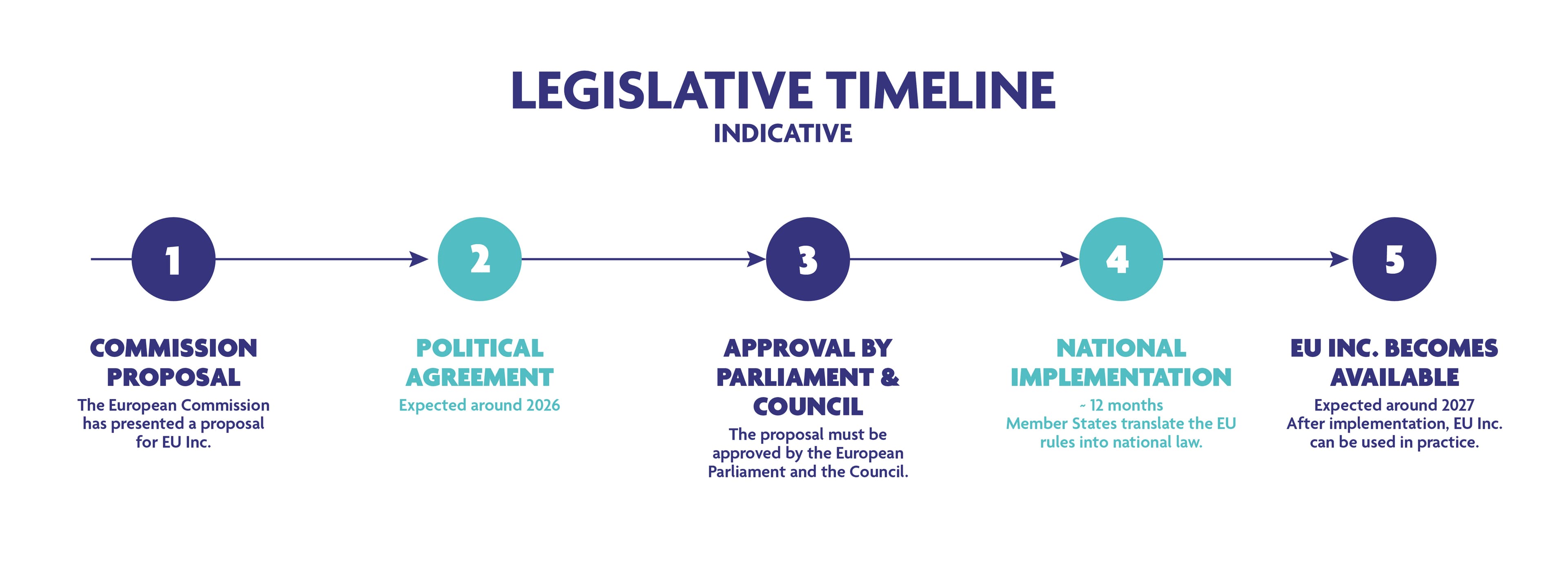
The European Commission aims to finalise the proposal relatively quickly. Current expectations are that EU Inc. could be adopted within the coming year, with application roughly 12 months later.
So while you can’t use EU Inc. yet, it’s no longer a “maybe someday” idea - it’s actively moving forward.
EU Inc. is not available yet, but it is no longer just theoretical.
Supporting international growth in practice
From an imec.istart perspective, founders are already building across borders, even if the system still forces them to operate country by country.
Across our imec.istart branches in Belgium, the Netherlands, Italy and Spain, we see how fragmented markets and regulation slow that down. Through our collaboration with Allied for Startups - and with our Program Director Sven De Cleyn advising EU Commissioner Zaharieva - we bring these realities into the European policy conversation.
Europe’s challenge is not ambition, but structure. EU Inc. is a step toward closing that gap.
For founders, the takeaway is simple: this won’t change your life overnight, but it’s something you’ll want on your radar as you think about structure, fundraising and hiring across borders.